
Working Capital for the Weeks Between a Hardware Order and the First Payout
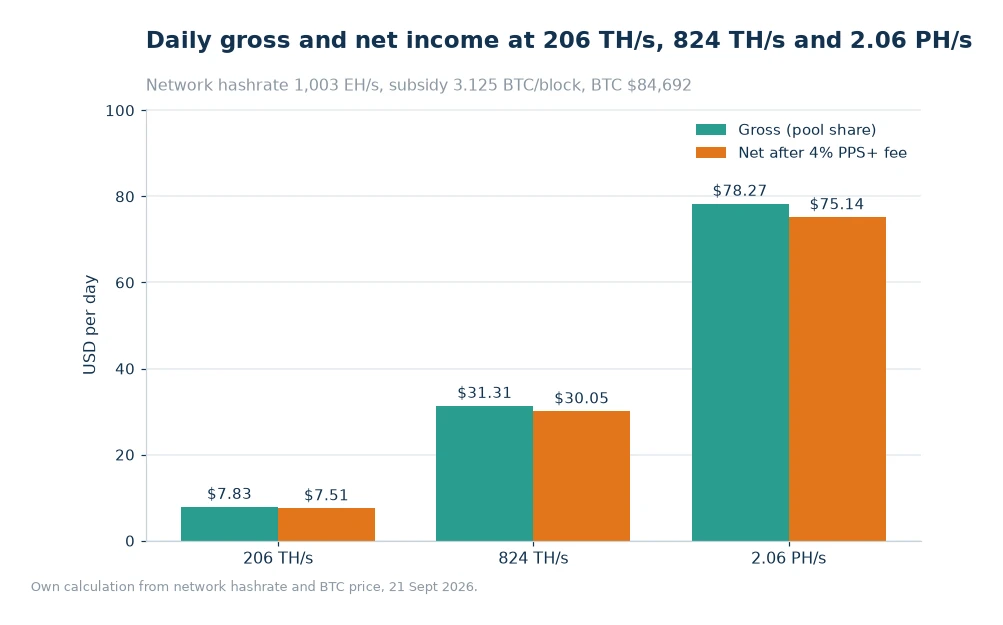
A miner at 206 TH/s earns 0.00009242 BTC a day gross, $7.83 at $84,692, and $7.51 after the posted 4% on the block-reward piece. The awkward part of buying hardware is that the invoice for the machine arrives months before that first credit does. Bridging that gap with borrowed coins is a cash-flow decision, and it should be sized like one.

Key takeaways
- A draw should cover the gap to first payout plus one month of running costs, not the entire hardware price.
- At 206 TH/s a $600 hole closes after about 80 days of net credits at $7.51 a day.
- Collateral-Pledged Loans release only at the end: Redeem Collateral comes after Repay Loan, never before.
- If delivery slips, the loan term does not slip with it, so keep at least a month of payments in reserve.
The invoice that arrives before the income
Hardware is paid for up front. Power, rack space and the customs broker are paid monthly. Coins arrive hourly once the machine is hashing, but the first hashrate reading is weeks or months behind the wire transfer. That sequencing, rather than the profitability of the machine, is what empties a small operator's account in the middle of an expansion.
There are only three ways to close the gap: hold cash, sell coins, or borrow against coins. Cash is cheapest and hardest to accumulate when hardware looks attractive, because that is precisely when everyone is buying. Selling is instant but permanent. Borrowing is the middle option, and it works only when the amount borrowed is matched to the length of the gap rather than to the size of the purchase.
What the draw is actually for
Split the expansion budget into two piles. The first pile buys the machines and is a capital decision that a loan should not normally finance, because the asset can lose value faster than the debt amortises. The second pile keeps the operation alive until the new machines pay: power deposits, import duties, a spare PSU, the first month of a hosting contract.
That second pile is the natural target for a coin-backed draw. It is small, it is short-lived, and it has a clear end date when the new hashrate starts producing. A draw sized to that pile is repaid by the very cash flow it was waiting for, which is the only kind of borrowing that closes cleanly.
The five stages, and where people stall
The ViaBTC Crypto Loan sequence starts when you post coins (Add Collateral), moves on as you submit the request (Apply for Loan) and take the funds (Receive Loan), and only unwinds once you pay the balance back (Repay Loan) and redeem what you pledged (Redeem Collateral). Stalls cluster in two places. The first is Apply for Loan, where a miner asks for the full hardware price instead of the working-capital slice. The second is Repay Loan, where the repayment currency is chosen at the last minute.
Collateral is the constraint that decides everything else. Posting coins you might need to sell during the gap defeats the purpose, because a price drop can force you to add collateral at the exact moment you are least able to. Post the portion of the stack that was not earmarked for anything, and keep a separate reserve for the monthly bills.
Thirty days of credits against a $600 hole
The table tracks a $600 draw as the new machine comes online. Credits are net of the posted charge, and the outstanding balance assumes no other payments are made during the month. In practice a miner would repay weekly and finish sooner.
| Day | Cumulative BTC | Value at $84,692 | Still owed |
|---|---|---|---|
| 7 | 0.00062111 | $52.57 | $547.43 |
| 14 | 0.00124222 | $105.14 | $494.86 |
| 21 | 0.00186333 | $157.71 | $442.29 |
| 30 | 0.00266190 | $225.30 | $374.70 |
Thirty days removes a bit more than a third of the draw. That is the number to hold against the loan term: if the term is three months and the gap is six weeks, the schedule is comfortable. If the term is one month and the gap is six weeks, the plan is already broken before the first share is submitted.
The collateral you can afford to lock
Locked collateral is not gone, but it is unavailable. That distinction matters during an expansion, when surprises arrive in pairs: a board fails and a power bill lands in the same week. Coins posted against a loan cannot absorb either surprise, so the reserve kept outside the loan has to be large enough for both.
A workable split for a small operation is to post the long-held portion of the stack and keep the recent payouts liquid. The long-held coins were never going to be sold at a moment's notice anyway; the fresh credits are the operating float. Mixing the two is how a miner ends up borrowing a second time to cover a repair, at whatever terms are available that day.
If the shipment slips a month
Delivery dates move. When they do, the loan does not move with them: the term still runs, and the credits that were meant to service it are still missing. Build the schedule on the later of two dates — the promised delivery and a month after it — and check that the arithmetic still holds. If it does not, halve the draw rather than stretching the term.
A smaller draw repaid early is cheap and forgettable. A larger draw that needs a second loan to survive a delay is how a modest expansion becomes a balance-sheet problem. The point of the facility is to smooth a few weeks, not to underwrite a strategy. Keep the borrowed figure inside the range your existing hashrate could service on its own if the new machines never arrived.
Worked example at 206 TH/s
The arithmetic follows the same path as the chart, starting from the network's daily output and working down to a repayment date.
- 450 BTC a day ÷ 1,003,000,000 TH/s = 0.00000044865 BTC per TH/s.
- 206 × 0.00000044865 = 0.00009242 BTC a day.
- 0.00009242 × 84,692 = $7.83 gross.
- Net of the 4% block-reward charge: 0.00009242 × 0.96 = 0.00008873 BTC, or $7.51.
- $600 ÷ $7.51 = 79.9 days, so the draw clears on day 80.
- Day 30 of that run leaves 0.00266190 BTC earned, $225.30, and $374.70 outstanding.
Frequently asked questions
Should a loan pay for the miners themselves?
Usually not. Finance the short gap around the purchase — power deposits, duties, spares and the first month of hosting — because that money is repaid by the new hashrate; borrowing the full hardware price stretches the schedule past the point where the machines may still be competitive.
How much does 206 TH/s clear in a month?
About $225.30, or 0.00266190 BTC, after the posted 4% on the block subsidy, which retires a little over a third of a $600 draw in 30 days.
What happens if the machines arrive late?
The term keeps running while the credits are absent, so size the draw against delivery plus a month and keep one payment in reserve; halving the draw is a better response to a delay than extending the term.
Match the draw to the gap, then stop
Before applying, write the gap in weeks and the draw in dollars on the same line. If dividing the second by the daily credit your rigs produce gives a number of days longer than the gap plus a fortnight, the size is wrong. The Miner Profitability Ranking is a useful cross-check on what a given model earns at today's difficulty, and the pool state page shows whether the network is moving for or against you. Both answer questions the loan cannot.
Sources: ViaBTC loan, miner ranking and pool state pages, with chain data read 21 Sept 2026 — 1,003 EH/s network hashrate, 132.76 T difficulty, 3.125 BTC subsidy, 144 blocks a day, BTC $84,692. All repayment figures are arithmetic on those inputs with continuous uptime assumed. Published 24 Oct 2026[1].