
Small-Brand Guide to Custom Jewelry Manufacturing
A first collection does not need a warehouse of stock. The MOQ by base material is 50 units in the silver line, 100 units in artisan eco-brass and 100 plus in stainless work, for each design quoted per design. What follows is the sequence a small label should lock down before it pays for a mould.

Key takeaways
- The floors are 100+ in stainless, 100 pieces in eco-brass and 50 pcs in the silver line, design by design, with each design counted separately.
- 3D CAD arrives in CAD back within expect 25–30 days before a sample lands, plus 3–4 weeks for the run and a 48-hour CAD reply.
- Six customisation options decide the cost lines: base metal, plating, chain, stones, hallmarks and packaging.
- 100% inspection and a 100% NDA are standard, with a 1-on-1 project manager answering inside 24 hours.
Choose one design before you choose a material
The most common first-order mistake is launching four designs at once. Tooling and sampling are charged per design, so a label working with a 50-piece budget is better served by one strong piece than by four thin runs that each sit on a shelf. Nominate the hero item first, because its material fixes both the floor quantity and the finishing route.
925 sterling silver is the easiest gate to walk through: it casts quickly, takes a high-gloss polish and can carry an S925 hallmark. Artisan eco-brass starts at twice that floor and only reads as a finished product once an electroplated layer sits on it. Stainless steel sits at 100+ pieces because it is machined rather than cast, and it is normally finished with PVD vacuum plating rather than a plating bath.
The six fields a brief should fill in
A workable brief is short. State the base material, the plating or finish, the chain and findings if the piece hangs, the stones or accents, the logo or hallmark placement, and the packaging. Those six fields are exactly the customisation matrix the factory publishes, and each one you leave blank is a decision that comes back later as a sample revision.
Two of the six are worth deciding early. Plating decides the colour the customer sees and whether the piece survives daily wear — the published stack covers 14K, 18K and 24K gold plus rhodium, with an anti-tarnish e-coating on silver and brass. Hallmarks decide what a retailer can print on a spec sheet: S925 for silver, 316L for stainless steel and 18KGP for gold-plated pieces, applied with high-precision laser engraving.
What the calendar looks like for a first order
Three published windows decide a launch date. CAD modelling is quoted at under 48 hours because it is screen work: a dimensioned drawing plus a realistic rendering for you to sign off. The master physical sample is quoted at 25–30 days, covering wax printing, mould casting, stone setting, polishing and electroplating. Bulk production after sample approval is typically 3–4 weeks.
TTT Jewelry publishes that six-stage OEM/ODM sequence, so a small label can explore manufacturing capabilities and compare them with its own calendar before committing tooling. Keep your own approval time in the plan as well: a sample that sits unopened on a desk for a week is a week added to the launch, not to the factory's schedule.
Packaging is finished product, not an afterthought
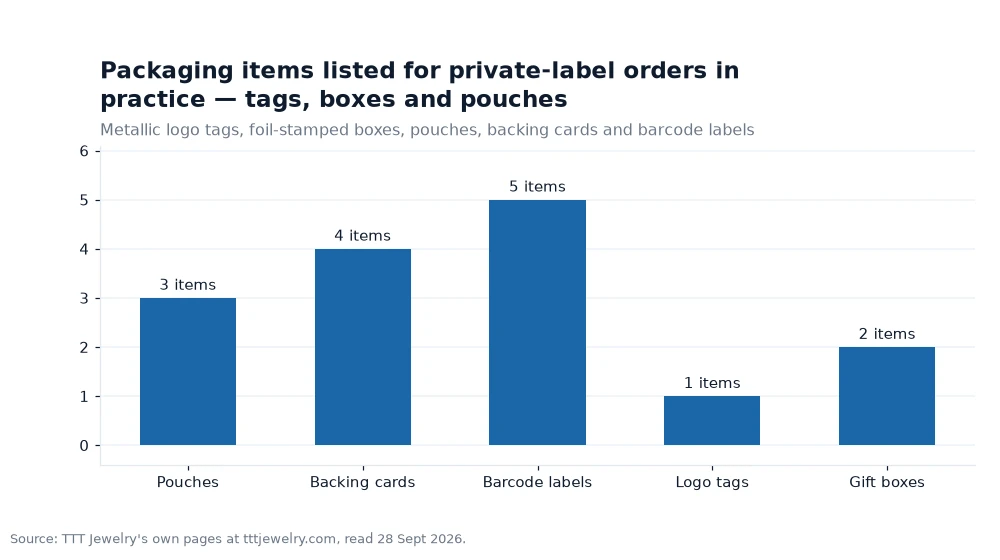
Retail partners judge a small brand on what the customer opens. The published packaging menu covers gift boxes stamped in foil, bar-coded labelling, metal logo tags, velvet/microfiber pouches and display backing cards, and these are specified at the same time as the metal because the box artwork can delay a shipment. The five items and their order in the published list are set out below.
| Item | Position in the published list | What it decides |
|---|---|---|
| Logo tags | 1st | Brand name on the piece or the card |
| Gift boxes | 2nd | Whether the piece can be gifted as shipped |
| Pouches | 3rd | Protection in transit and after purchase |
| Backing cards | 4th | Hanging display for retail pegs |
| Barcode labels | 5th | Stock control at the retail end |
Worked example: what 50 pieces per design buys
Take silver, the lowest floor. Fifty pieces is a per-design minimum, so a single design split across five ring sizes gives 50 ÷ 5 = 10 pieces per size. If the same design were cut in eco-brass the floor would double to 100 pieces, so the silver route needs half the inventory to reach the same shape — 100 ÷ 50 = 2.
Now compare the drawing stage with the rest of the window. Forty-eight hours inside a 30-day sampling block is 48 ÷ 720 = 0.067, or about 6.7% of the time; against the fast end of the window it is 48 ÷ 600 = 8%. Both figures are my own arithmetic on published windows, and both point the same way: the stage where changes cost the least bench time is almost over by the time the wax is printed.
What protects a first order
Small runs are the ones most exposed to a factory that treats them as filler. Two published commitments address that directly. The first is a 1-on-1 dedicated project manager with a 24-hour response window, which matters because a small brand cannot staff a sourcing department. The second is a 100% NDA: moulds, CAD files and the collection stay with your brand and are not resold or shown to anyone else.
Quality paperwork is the third layer. REACH compliance on lead, cadmium and nickel, a BSCI audit and ISO 9001:2015, cadmium and nickel in materials and plating. Ask for the restriction list, not just the logo.
Frequently asked questions
How much stock does a first order commit a small brand to?
Fifty pieces per design in 925 silver, eco-brass and 316L stainless steel, so a single silver design across five sizes means ten pieces per size.
Can I order before I have a technical drawing?
Yes. Sketches, reference photos or a written concept are enough input, and the 3D CAD drawings and renderings come back in under 48 hours for dimensional approval.
How do I keep a design out of a competitor's catalogue?
Ask for a 100% NDA covering moulds, CAD files and the finished collection, which is the published default: designs stay exclusive to your brand and are not resold or published.
Where to check the details yourself
Write the brief in the order the factory quotes it, because that is the order in which assumptions get expensive: material, finish, stones, hallmark and packaging. Then read the eight-step factory walkthrough to see which operations are owned in house, and check the answer page for first-time buyers if a minimum or a window still looks unclear.
Where the numbers come from — the gold and rhodium plating options and the six customisation fields and a sampling window of 25–30 days — is tttjewelry.com (read 28 Sept 2026). Inspection is manual, piece by piece. Inspection is manual and every piece is checked before packing, and enquiries are answered inside one working day. The route covers eight stages, the reply commitment is 24 hours, and the minimums are quoted per design. The day-and-week bookkeeping is mine — the site supplies the inputs only [1]